

Special Collections Blog Archive
Get ready! National #AskAnArchivistDay is Next Week!
Posted
Have you ever wished you could have all of your archives-related questions answered by an archivist? Well you're in luck! October 4, 2017 is national Ask an Archivist Day, sponsored by the Society of American Archivists. Our University Archivist, Kim Sims, will be ready to respond to your questions! Just add @SwemSCRC and #AskAnArchivist to your tweet on October 4.
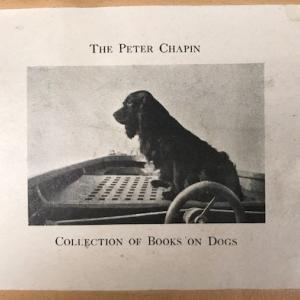
Must Love Dogs
Posted
If you've ever visited the Special Collections Research Center, you may have learned that we hold the second largest collection of books about dogs in the United States, second only to the American Kennel Club. I love dogs and thought it would be fun to write a series of blog posts highlighting the dog book collection. This brief introduction to the collection will be the first.
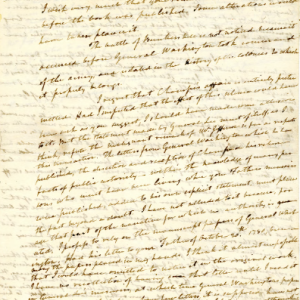
John Marshall Letters Document Writing of George Washington's Biography
Posted
In December 2016, David B. Wolf, a New York attorney and collector interested in John Marshall and his biography of George Washington, donated three letters that join an existing collection of John Marshall Papers.
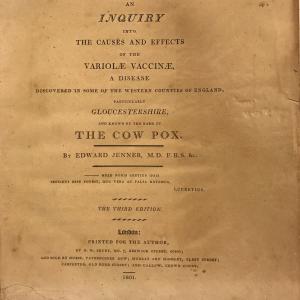
"The Looted Book"
Posted
Institutional knowledge is an awesome thing and something that is often taken for granted and/or overlooked. I recently learned a cool story surrounding one of the rare books housed in Special Collections, thanks to former Dean of W&M Libraries, Nancy Marshall.
Mosaic Intern's Work Offers Glimpse of Artistic Text
Posted
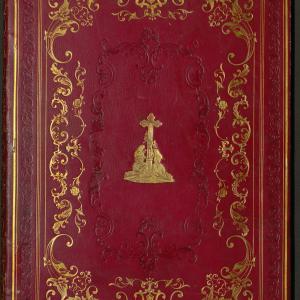
What do Indiana Jones and the Content Services Mosaic Intern have in common? We both spend our days searching for historical treasure: in my case that involves paging through old texts—often plain or even dirty in appearance—researching their autographs and marginalia, and mining valuable snippets of the lives of people important to both our local and national history.
Instruction in Special Collections: A Closer Look at SCRC's Recent Acquisitions
Posted
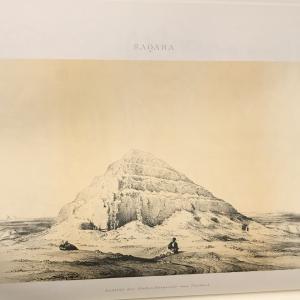
With a goal of not only collecting and preserving texts and objects for future generations, the Special Collections Research Center is devoted to acquiring books and artifacts that can benefit instruction at William & Mary. Chinese scrolls, facsimiles of medieval texts, and a replica of Dead Sea scrolls are just a few examples of items in the SCRC that faculty have frequently used in their teaching.
Work at SCRC Involves More than Books: An Intern's Perspective
Posted
"You work at the library? So, do you put books away and stuff?" Er – no. While our vast collection of books is one of the astonishing things that I love about Earl Gregg Swem Library, on a normal day I am usually sliding between computer screens, meetings, and the occasional trip to the Daily Grind.
An Intern's Experience in Special Collections
Posted
From the warm and welcoming reading room to the frigid ground floor stacks, the Special Collections Research Center offers a wealth of historical resources, right at the heart of campus. I am grateful to have the opportunity to take a behind-the-scenes look at the SCRC and explore many of its treasures this summer through Swem Library's Mosaic Internship Program.
"[T]o be published in the usual places": The proclamation of William & Mary as King and Queen
Posted
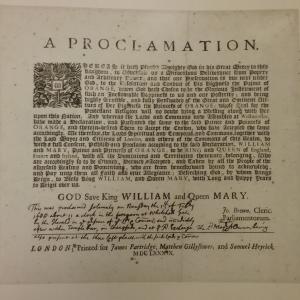
What is the difference between printing and publishing? This is perhaps something many of us don't think about, but there is a difference. After all, we now speak of things being published on the internet, so there is not an inherent relationship between print and publication, at least not anymore. Two documents from the Thomas G.

A Lover of Words Reveal'd
Posted
Swem Library holds two editions of A grammar of the English tongue, with the arts of logick, rhetoric, poetry, &c., but it is in the earlier one, printed in 1714, that we find something unexpected and extraordinary. This volume belonged to Samuel Clark, who, according to Alumni Oxonienses by J. Foster, matriculated at St. John's College, Oxford in 1725 at age 18, graduated BA in 1729, MA in 1733, and BD in 1738.
Bingo Finds his Way to Belarus: Yiddish Dog Books in the Interwar Period
Posted
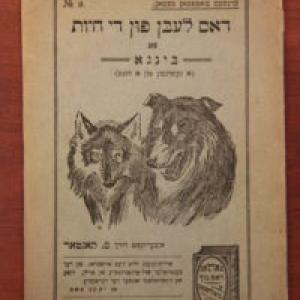
Many of the treasures in Special Collections don't actually live in the stacks downstairs but are instead housed in Swem Library's Offsite Stacks (SOSS). Most materials are kept in SOSS either because they are infrequently requested through Special Collections or have specific requirements for the environment in which they must be housed.
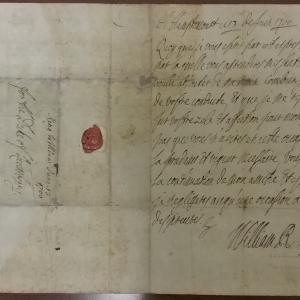
"From my hand": A letter written by King William III enters Swem Library Special Collections
Posted
On the fourth of July, 1698, an expedition set out from Scotland. The small group of ships set a course for the Isthmus of Darien in modern-day Panama, intending to create a Scottish colony that would be an overland trading link between the Atlantic and Pacific Oceans--a seventeenth-century Panama Canal.
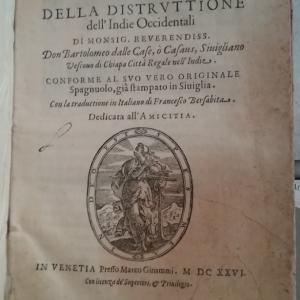
Printing Anti-Spanish Propaganda for European Purposes
Posted
It may seem like Spanish empire in the Americas would have little to do with European politics, but we should not assume that the Atlantic world of the sixteenth and seventeenth centuries was any less global than our own.

Williamsburg before Williamsburg
Posted
William & Mary was founded before the City of Williamsburg, the former in 1693, the latter in 1699. The original of this map, however, was made at some point before 1683, and was used by the Lords of Trade and Foreign Plantations in London in their administration of the colonies. It shows the area where Williamsburg and the College would be built, at least a decade before they came into being.
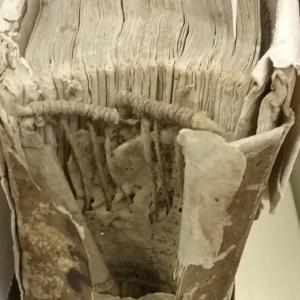
The ties that bind: How the decay of a binding shows its construction
Posted
Swem Library has a great many books in very bad bindings. Most modern books, for instance, are held together only by glue at the spine. Even modern hardcovers have the same binding. Other than the hard shell surrounding them, they are in all other respects exactly the same as a cheap paperback. In the past, however, bindings were much stronger.
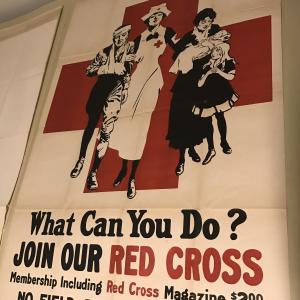
Remembering World War I
Posted
On April 6, 1917 the United States entered World War I, then known as the Great War. A century later, objects in Special Collections reveal memories of Americans' lives at wartime. Among the variety of materials available for research are a collection of Red Cross posters, a veteran's scrapbook, and a nurse's correspondence with loved ones.
The World Before QWERTY
Posted
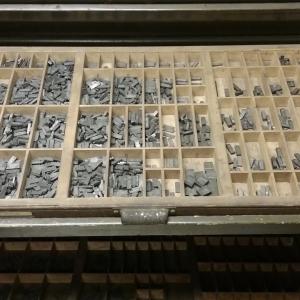
Can you type without looking at the keyboard? This used to be a skill taught to people who wanted secretarial or clerical jobs. Now of course many of us type quickly because we use computers on a daily basis. But what about the predecessor to the keyboard we know? This is it – a typecase, filled with individual letters which had to be assembled by hand to create anything which needed to be printed.
Believable Lies
Posted
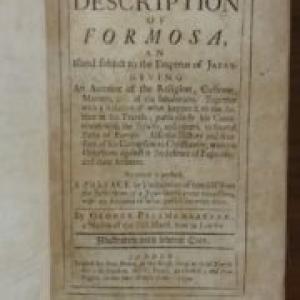
The island of Taiwan, once commonly known in the West by the Portuguese name of Formosa, has recently resurfaced in the news in connection with the One China policy. In the past it was also a subject of interest, although information coming from Taiwan itself was often scarce.
Propaganda and the Beginnings and End of Spanish America
Posted
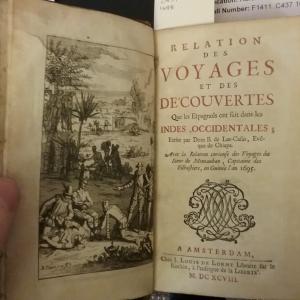
The arrival of Europeans in the Americas was an event of global importance, and its effect on the people already living here was devastating. That is why in 1552 the Dominican friar Bartolomé de las Casas wrote a book that he called Brevísima relación de la destrucción de las Indias, or A Short Account of the Destruction of the Indies.
Jennie's Search for "More to Life" in Maurice Sendak's "Higglety Pigglety Pop!"
Posted
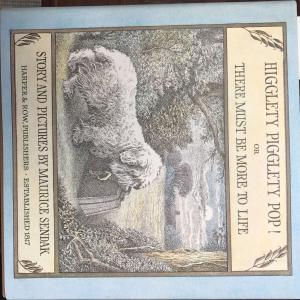
Most of us, if we recognize the name Maurice Sendak, probably think of him as the man who wrote and illustrated the beloved children's book "Where the Wild Things Are," published in 1963. Yet what some may not know is that Sendak wrote (and illustrated) much more than that one popular book.